
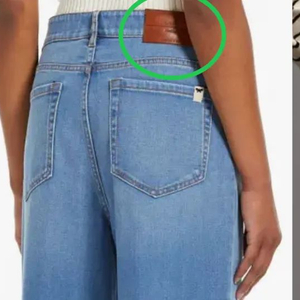

As a fashion item almost everyone has in their wardrobe, jeans may differ in style and colour, but one detail is common to many: a rectangular leather label on the waistband.
Some feel this label pairs naturally with jeans and even adds a decorative touch; others complain it is redundant, stiff, digs into the waist, sometimes picks up other colours, and a few even cut it off by hand. So what is this leather decoration for, and why keep the design?
The leather decoration on jeans is an important identifier, usually at the back waist, originally made from thick cowhide. In English it is called a "leather patch," later also "leather label" or "leather badge," and more commonly known as the "leather patch" or "leather badge ()."
The leather patch was first created by Levi's. In 1886 Levi's added a patch at the back waist to mark the model number, printed with an advertisement: two horses, whipped by two men, pulling a pair of jeans in opposite directions, with the words "They don't tear" underneath — a clever design meant to prove the jeans' sturdiness.
At the time, beyond proving quality, the patch also let wearers hang tools, reducing wear on the trousers themselves. Early jeans were worn mainly by gold miners, who needed to hang various tools at their waist; the patch made drawing tools easier while lowering the chance of tearing pants or belt. Later, as jeans spread, the patch became a mark distinguishing genuine from counterfeit. When Levi's launched, many small workshops produced poor imitations; to tell them apart, the small leather patch became an anti-counterfeit mark — genuine leather was costly and printing the pattern required skill, so counterfeiters struggled to copy it perfectly for a long time.
That makes the jeans leather patch nearly 140 years old, from the late 19th century to today. One theory is that cowhide's solid, durable character resembles the optimistic, hardworking cowboy spirit, so the patch endured. Today it carries new functions and meanings.
First, visually, the patch is the "face" of the jeans. Most brands print their name or logo on it — a form of advertising — letting people identify the product at a glance. Some go further, marking size and model. The patch's anti-counterfeit role also persists: branded patches are finely made with strict detail requirements, and their texture, stitching and pattern precision are considered markers of jeans quality.
Beyond promotion, the patch serves a practical purpose: it can secure the belt. Some patches are sewn tightly only at top and bottom, with open sides, so the belt can pass through the middle — fixing the belt position without hiding the brand logo. Legend also says the patch hid a small blade for self-rescue in Westerns — though that is best left to fiction.
Though called a "leather patch," the material is not necessarily real leather. In 1936 the American brand Lee created a horsehair patch with the brand name printed on horsehair. From an eco angle, some brands developed paper patches — Levi's stopped leather patches in 1954 in favour of paper, and in November 2018 Sweden's Nudie Jeans announced all new jeans would use paper patches, made from a material called "Jacron."
Jacron is made from specific wood fibre and natural fibre; in composition it is paper, but in appearance it resembles leather. Low-cost yet very strong, the "paper patch" is three-in-one: washable and wear-resistant, near-indistinguishable from leather, and above all eco-sustainable. Besides leather and paper patches, cloth patches are light and soft and fit jeans well, so some brands use fabric. Today the common patch materials are mainly cowhide, paper and cloth.